
Walls that Inspire: The Artist's Process Behind Every Creation – Rumi’s Kitchen

Updated: May 17
When you walk into a Rumi’s Kitchen restaurant, you aren’t just there for the carefully prepared, fresh, healthy Persian cuisine. You are signing up for the whole experience; this includes attentive Persian hospitality and an atmosphere filled with love and fine details.

This detail extends to the carefully designed and created interiors and this is where I was very happy to lend my expertise. I have worked now on four Rumi’s Kitchen locations, first in Mount Vernon Square, Washington DC and most recently in Sandy Springs, Atlanta, GA.
Together with The Johnson Studio at Cooper Carry, and my own solid team, I have installed beautiful interiors crafted from rustic plaster and hand-painted murals to reflect these values.

Plaster as a symbolic process
Named after Persian mystic and poet, Rumi, the design of the restaurants’ interiors leans into Rumi’s important contributions to the region’s culture. The interior design team decided upon ruined and rustic plaster walls to create a striking ambience. These walls became the perfect canvas to work on.
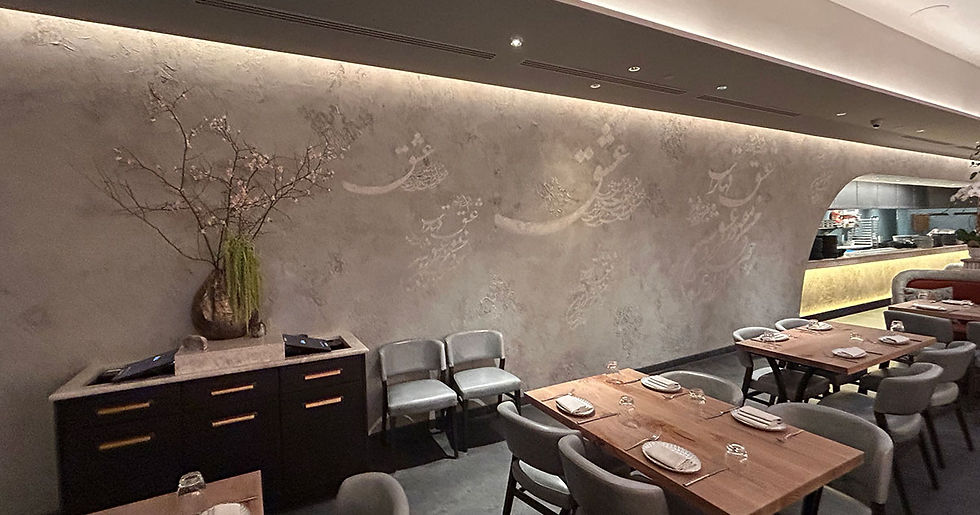
In the DC restaurant, this included a bas-relief feature wall depicting ancient whirling dervish dancers, while in Atlanta, Rumi’s own words pull through the plaster.

The rustic plaster walls have been a feature we have extended across to subsequent new locations, keeping a theme while ensuring each is unique. For the most recent Rumi’s in Atlanta, the interior wall of main dining room is inscribed with faded poems by Rumi and plaster relief Persian motifs adorn the old plaster wall.
Together with my team, I created these stunning feature walls from scratch. The designs were carved out of the plaster, revealing the venerable brickwork beneath. We penetrated through layers of plaster to set free the poetic images hidden beneath.
The artist’s process
I typically render my designs in a sketchbook, before digitizing on a computer. I then break the design into three colors, and these colors help provide depth – similar to a stencil.
Finally, I began the carving process with chisels, hammers and other tools. These tools allowed my team and I to create incredible and truly poetic portraits. This entire process is very symbolic and I view it as a semi-archaeological dissection of layers of history and culture.
“This entire process is very symbolic and I view it as a semi-archaeological dissection of layers of history and culture.”
I divide the carvings into layers of images and then begin by destroying to create, after all, destruction is a form of construction.

Dimension & drama with painted murals
The most recent Rumi’s renovation included some exciting new opportunities for artwork. Notably, the feature exterior mural welcomes the world to the recently renovated vibrant and Persian-inspired restaurant. The design features The Simurgh, the Persian sacred bird, along with the Farsi script عشق (Eshgh), which means “love".
My mural moves beyond a simple, pretty painting to become a lasting, symbolic Persian narrative that resonates universally, blending strong emotional impact with simple, memorable composition. Lit at night, the mural comes to life with added dimension and drama.

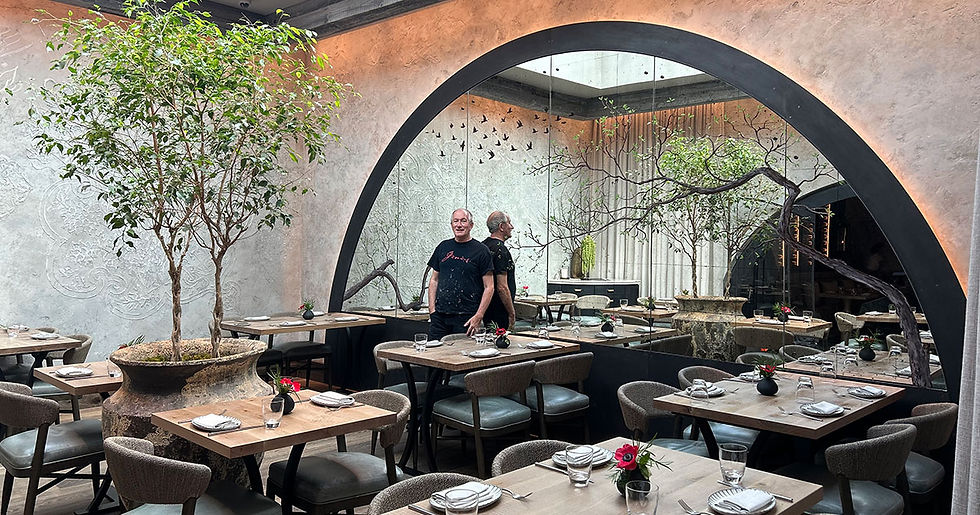
Back inside, the private dining room offered more opportunity for creative expression. A large-scale custom hand-painted mirror brings light and drama to the room, inspired by the ancient Persian poem, The Conference of the Birds.
In addition, the walls of both the private dining room and the main dining room feature Farsi script and relief stencil designs of Persian motifs on old plaster walls. The effect of these interiors is profound and has to be seen to be truly felt.
These projects have truly satisfied the artist within me, and it’s been a privilege to work alongside Rumi’s and the Johnson Studio to bring these interiors (and exteriors) to life.
If you have a project that needs to be simply ‘more’, then get in touch to see how a custom painted mural or plaster effect wall could elevate your interior design.


Comments